Sunday, 24 February 2013

THE MIRACLE PLAY


THe outburst of English Drama is so pre-eminently the glory of the Elizabethan period of literature proper, that it has seemed on the whole better to take no detailed notice in the preceding Books of the early experiments- not very early, not very numerous, and not of the first importance in literature- which we possess in that literary kind.


The modern drama did arise out of the Miracles. The Miracles did pass into the Moralities. The Moralities did pass into modern dramas. and though the imitation of the ancient classical drama, and its performance in school and universities, coloured, shaped, generally influenced , the modern drama most momentously, this drama no more arose out of them than Spenser arose out of Virgil, or Hooker out of Cicero.

Miracle play or Mystery play, form of medieval drama that came from dramatisation of the liturgy of the Roman Catholic Church. It developed from the 10th to the 16th cent., reaching its height in the 15th cent. The simple lyric character of the early texts, as shown in the Quem Quœritis, was enlarged by the addition of dialogue and dramatic action. Eventually the performance was moved to the churchyard and the marketplace. Rendered in Latin, the play was preceded by a prologue or by a herald who gave a synopsis and was closed by a herald's salute.

It is sufficient to say that we have from France Latin mystery or miracles plays which may be of eleventh century, Latin mixed with a little French nearly as early, and plays wholly in French which are as old as twelfth.The four great collections known by the names of their place of performance, are the York, Wakefield, Coventry, Chester plays. we have one of a Newcastle cycle, one of a Dublin,an East-Anglian version of Abraham and Isaac, one norfolk"Digby Mysteries" and the oldest of all , the Harrowing of the Hell.


Towney Plays ms., opening of The Second Shepherd's Play. HM 1 ff37v-38; courtesy of the Huntington Library.

 A very little examination of these plays will show the astonishing fallacy of the proposition that the modern drama. Instances of indirect connection are to be found especially in the story of The Ark and the Tower of Babel,both of which were fixed on almost from the first as opportunities for comic play and digression. The great instance of the sheer addition is the famous 'Second Shepherds'play , not merely comic , but of absolutely romantic treatment .

Wednesday, 6 February 2013

THE FOUR GREAT SCOTTISH POETS

IT has constantly been remarked as most curious and partially unaccountable phenomenon, that while Chaucerian poetry, as soon as Chaucer's own hands failed, gave nothing but third rate work or worse in England it produced in Scotland work in some cases of very high quality indeed. Such account as is possible of the reasons for the general lateness of purely Scottish literature has been given in  this  chapter . In this I;ll give an account of the four chiefs of Scottish poetry when it did come-James the first, Robert Henryson, William Dunbar, and Gawain or Gavin Douglas.

1-James Stewart 

 Criticism of the strenuously inert kind has played its usual games with the literary work of James Stewart,first king of  the name on England. After by turns attributing to him and taking away from him Christ's Kirk on the Green, Pebbles to the Play, etc., it has recently attacked his claims, which for nearly four centuries had been undisturbed, on the King's quair itself. this James would naturally have been, seeing that he was born in 1394, captured at sea by the English in 1405, kept in honourable captivity in England till 1424. The King's quair may be ranked as the two most graceful, scholarly and elegant poems of the french-Chaucerian tradition to be found in English. The Ballad of good Council, which is also ascribed by good authority to James, and is the only other piece bearing such attribution.


  2- Robert Henryson


Few poets whose personality is certain, and whose work is both eminent in merit and not inconsiderable in bulk, have a more shadowy record than master Robert Henryson, schoolmaster in Dunfermline, as he is entitled in editions of his work printed some sixty or seventy years after his death.About his work, however, there is no reasonable doubt. They consist of two poems of some length, the Testament of Creseide and Orpheus and Eurydice; of a collection, with prologue, of Aesopic fables in Scots;and of rather more than dozen minor poems. There is,however, no doubt that Robene and Makyne Malkin, the best known of Henryson'soem. The remaining members of this small but admirable collection of verse are less interesting, though much above the standard of their time.

3- William Dunbar


It is usual to rank William Dunbar as the chief of all this group, and in fact the greatest scottish poet except Burnes.He was certainly a Lothian man, probably allied not mearly in name to the great family of the Earls of Dunbar and March. The year 1460,with the usual circa, is accepted as his birthdate.The two most considerable are The Twa Maryit Wemen and the wedo and the Friars of Berwick. Both are very strongly Chaucerian. Next to these two may be ranked the Golden Targe, The flyting of Dunbar and Kennedy, the famous Dance of the Seven Deadly Sins,and The Thistle and The Rose.

4-Gawain douglas  


The last of the four poets to be mentioned here is also the least, though he has an interest of his own. Gawin or Gawain douglas was the third son of Archibald douglas. it is not known at which of the numerous seats of the Douglasses he was born but the date must have been 1474-75.In 1501 he finished the Palice of Honour.Between this and the year of Flodden, 1513, in the summer of which he finished Virgil, we hear little of him. In order to come to a just estimate of this, though the Virgil itself will give us sufficiant data, it is before all things neceassary to considerhis originals poems, the palice and Honour,and King Hart.

Sunday, 6 January 2013

JOHN WYCLIFFE


                                                    John Wycliffe (1320-1384) was a theologian and early proponent of reform in the Roman Catholic Church during the 14th century. He initiated the first translation of the Bible into the English language and is considered the main precursor of the Protestant Reformation. Wycliffe was born at Ipreswell (modern Hipswell), Yorkshire, England, between 1320 and 1330; and he died at Lutterworth (near Leicester) December.

                                                    John Wycliffe, "was an English preacher, writer and Bible translator who has been called "the morning star of the Reformation." He preached and wrote against various doctrines and practices of the Church of Rome, translated the Bible into English, and sent itinerant preachers (later called Lollards) throughout England to bring to the common people the the Word of God and the message of salvation through Jesus Christ,who was lived almost 200 years before the Reformation, but his beliefs and teachings closely match those of Luther, Calvin and other reformers. As a man ahead of his time, historians have called Wycliffe the "Morning star of the Reformation."

                         The work of wycliffe, a prose writer only, and a 'scared' and philosophical prose writer , is less novel, less attractive, but not less important. Little, despite his fame and the violent partisanship for and against him, is really known of the auther. we do not know when John Wycliffe was born or where, though the probabilities connect his birth with the place of Wycliffe-on-rees and the time of 1320-1325. He was certainly master od Balliol(a northern college) at Oxford, in 1360;and by the confession of his opponents,was a recognized expert in theology and scholastic philosophy.

                     The english work of Wycliffe and the Wyclifites (for a large part of the university of Oxford was saturated with his doctorine, and the complete body of Wyclifian literature is  rather an earlier 'Tracts for the Times'than the work of any one man) consists on the one hand of a new and complete  translation of the Bible, on the other of a considerable mass of tracts and sermons inteded for popular consumption.
                      
                      Wyclif is chiefly remembered and honored for his role in Bible translating. In the early 1380's he led the movement for a translation of the Bible into English, and two complete translations (one much more idiomatic than the other) were made at his instigation. (How much of the translating he did himself, if any, remains uncertain.) He proposed the creation of a new religious order of Poor Preachers who would preach to the people from the English Bible. Today, the Wyclif Foundation, named in his honor, is committed to translating the Bible into all the languages spoken anywhere in the world.Sources: (1) Every Man's Book of Saints (Mowbray's, London and Oxford, 1981); (2) Encyclopedia Britannica; (3) The New Catholic Encyclopedia; (4) H B Workman, John Wyclif: a Study of the English Medieval Church, 2 vol, 1926. (5)  George Saintsbury,A Short History of English Literature

Sunday, 23 December 2012

CHAUCER'S PROSE

                          The prose of the late fourteenth century in England is not to the mere literary taster, with one notable exception, at all comparable in interest to the verse of the same time. For this time was in fact the beginning of English prose properly so called.Before 1350 it may be doubted whether there is a single English work in prose.
                           At the great turning-point, however, which, though it must have come sooner or later anyhow,was undoubtedly determined to no small extent by the concentration of English patriotic sentiment, owing to the conquests of Edward3, prose did not merely, like verse, make a fresh start, it made start almost for the first time. From the later years of Edward and the reign of richard2, date four writers prose, each noteworthy in his own way,- Chaucer the poet, Wyclif the controversialist, Trevisa the chronicler, and  the shadowy personage long know,and perhaps even yet not entirely exercised, as   "sir John Mandeville". All were translators in less or greater degree, but all also were originals of English prose writing.
                           The interest of Chaucer's prose work, the Treatise on the Astrolabe, the translation of Boethius, Tthe Parson's Tale, and the Tale of Melibee, is almost entirely an interest of form; and in the last that interest is minimised and almost confined to the fitful and straggling emergence of blank verse, or something like it , at the opening. So too the Parson's tale, a translation , does not advance us very much further than the prose treatises by or attributed to Hampole and his followers in the first half of the century. It is good straightforward English, but shows no attempt at style, while the well-worn and strictly prescribed common form of its matter expresses further limitations.The Boethius and the Astrolabe are superior. The version of the first, even if it were intrinsically less attractive, would inevitably invite comparison with Alfred's at the dawn of modern English prose, and the often noble,never contemptible, matter of original could not and did not fail to stimulate an artist like the Chaucer. But the most valuable point of the Boethius as an exercise for the 'metres' which, especially when rendered by such a poet as Chaucer into a language with such illimitable latent possibilities  as English , must needs results far more ambitious and far more successful attempts in 'the other harmony' than had appeared.                       
                                 Accordingly some of the metre passages in Chaucer's version, though quite legitimate and sound prose, attain a rhythmical as well as verbal dignity, which English prose was hardly to know again save in a few passages of Malory,Fisher, Berners, and the translators of the Bible, till late in sixteenth century.And whole shows that, if it had suited Chaucer to write more originally in prose, he might have effected a revolution there in at least as great as that which he did effect in verse, nay greater , seeing that he had practically no forerunners.


Saturday, 24 November 2012

JOHN GOWER


  Almost exactly contemporary with Chaucer were two others poets, both of more than ordinary mark- one of than Chaucer's own equal, if not superior, in intensity, though far his inferior in range and in art, both curious contrasts in more ways than one with him, and with each other.The first was the author of the Vision of Piers the Plowman; the second was John Gower.
      
John Gower, (born 1330?—died 1408, London?), medieval English poet in the tradition of courtly love and moral allegory, whose reputation once matched that of his contemporary and friend Geoffrey Chaucer, and who strongly influenced the writing of other poets of his day. After the 16th century his popularity waned, and interest in him did not revive until the middle of the 20th century.
It is thought from Gower’s language that he was of Kent origin, though his family may have come from Yorkshire, and he was clearly a man of some wealth. Allusions in his poetry and other documents, however, indicate that he knew London well and was probably a court official. At one point, he professed acquaintance with Richard II, and in 1399 he was granted two pipes (casks) of wine a year for life by Henry IV as a reward for complimentary references in one of his poems. In 1397, living as a layman in the priory of St. Mary Overie, Southwark, London, Gower married Agnes Groundolf, who survived him. In 1400 Gower described himself as “senex et cecus” (“old and blind”), and on Oct. 24, 1408, his will was proved; he left bequests to the Southwark priory, where he is berried.
 Beside the shadowy and in part apocalyptic figure of Langland, the solid, well-authenticated, some what prosaic personality and literary work of John gower present a contrast which has its interest. His birth-year is not certain ; he died, old and it is said blind, in 1408, and his tomb is one of the numerous literary illustrations of the great and recently  rebuilt church of St. Saviour's, or St.Mary Overy's, Southwark, with Gower seems to have been connected in various ways. Indeed, though married, he appears to have been in minor orders.
Gower is the last of the probably not small  other than English men of letters between 1200 and 1400 who were trilingual- writing and probably speaking, French, Latin, and English with equal facility. The principal existing piece of Gower's French is a set of fifty Ballads, the favourite French form, with untwisted identical rhymes, a recurrent refrain, and an envoy. But he also wrote in French one of the three divisions of his capital work, the Speculum Meditates,a moral poem,another part of this ,the vox Clamantis, also exists, but is in Latin.a lively political poem in elegies.The Confessio Amantis, third and English part of Gower's Opus msgnum, is much less vigorous and spirited than either of this Latin poems.
Gower was both. The want of zest and rest in his literary style, and still more in his poetical medium, must not be allowed to blind us to the fact that both show an enormous improvement on such immediate predecessors as Hampole,as the author of The Pearl, as the author Cursor Mundi.He knows his craft far better than they did; he has better tools; he can teach others to turn out work that can be depended on.
 

WILLIAM LANGLAND

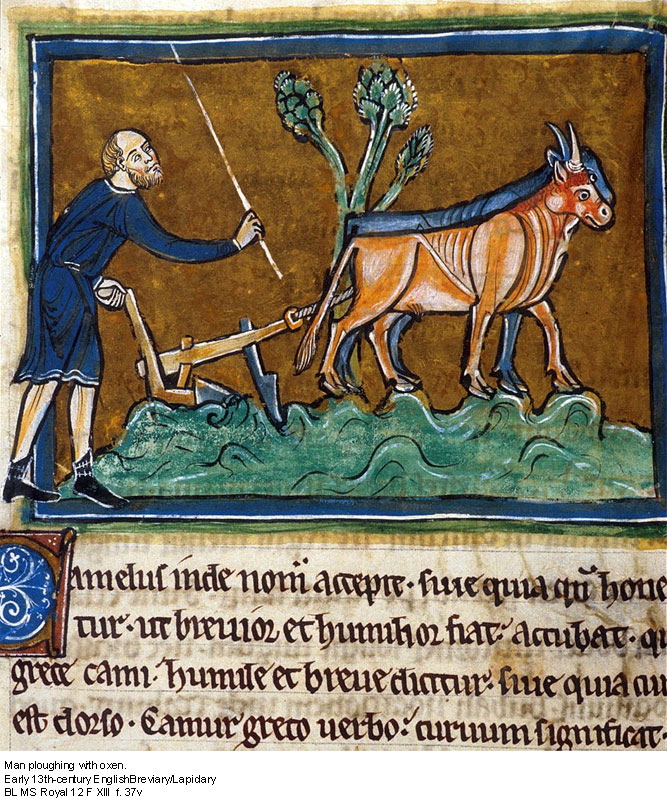
               Almost exactly contemporary with Chaucer were two others poets, both of more than ordinary mark- one of than Chaucer's own equal, if not superior, in intensity, though far  his inferior in range and in art, both curious contrasts in more ways than one with him, and with each other.The first was the author of the Vision of Piers the Plowman; the second was John Gower.       Man ploughing with oxen. Early 13th-century Manuscript.WILLIAM LANGLAND, the generally accepted author of the Medieval allegorical poem Piers Plowman, is a figure of whom there is no mention in contemporary records. Everything written about his life is educated conjecture based on Langland's texts and later allusions.

Langland was born sometime around 1330. In the B-Text of Piers Plowman, composed around 1377, Imagination says he has followed him "this five and forty winters." In the Dublin manuscript (D.4.1), a note in a fifteenth-century hand claims that Langland's father was one "Stacy de Rokayle." In mid-sixteenth century, Bale in his Illustris Majoris Britanniae wrote that Langland was from "Mortymers Clibury" (now Cleobury Mortimer) in Shropshire near the Malvern Hills where Piers Plowman opens. There was a hamlet named "Langley" nearby, which may explain his last name.1

The attribution of Piers to Langland rests principally on the evidence of a manuscript held at Trinity College, Dublin (MS 212). This directly ascribes 'Perys Ploughman' to one 'Willielmi de Langlond', son of 'Stacy de Rokayle, who died in Shipton-under-Wychwood, a tenant of the Lord Spenser in the county of Oxfordshire'. Other manuscripts also name the author as 'Robert or William langland', or 'Wilhelmus W.' (most likely shorthand for 'William of Wychwood'). The poem itself also seems to point towards Langland's authorship. At one stage the narrator remarks: 'I have lyved in londe...my name is longe wille' (B.XV.152). This can be taken as a coded reference to the poet's name, in the style of much late-medieval literature (see, for instance, Villon's acrostics in Le Testament). Although the evidence may appear slender, Langland's authorship has been widely accepted by commentators since the 1920s. It is not, however, entirely beyond dispute, as recent work by Stella Pates and C. David Benson has demonstrated.
Nevertheless he had a great literary talent, which perhaps amounted to genius. The literary craftsmanship which succeeds in impressing on a form so uncouth as the unrhymed and only faintly metred alliterative verse the combination of freedom and order, of swing and variety, which marks Piers Plowman, is of that kind which must distinguished itself whatsoever the form it happened to adopt. And although the architectonic gift, which might have enabled the poet to to present a real whole instead  of a series of dissolving views, ,is not present, yet it is astonishing with how little repugnance the reader who has once ''got his hand in'' accepts this apparent incoherence, and resigns himself to see the visions rise and gleam and melt, the bubbles swell and gleam and break. While as for the force of individual passages-the prologue, the fable, the best court scenes, the London Tavern, the Harrowing of Hell- these have never been mistaken by any competent critic who has read them.

Monday, 19 November 2012

GEOFFREY CHAUCER'S LIFE

The life of Chaucer has for greater part of century had its full share of that touching, if not always intelligent, devotion which justifiesthe theory that the human race is not after all indifferent to its heroes.There is no positive evidence of the the date of Chaucer's birth;for that of his death, 1400, we have not only tradition but the strong circumstantial proof that his pensions ceased to be paid at that time. He was pretty certainly the son the son of John and Agens Chaucer. Nor is there any doubt that Geoffrey Chaucer himself was in close  and constant connectionwith the Royal Family
.Geoffrey Chaucer (born 1340/44, died 1400) is remembered as the author of The Canterbury Tales, which ranks as one of the greatest epic works of world literature. Chaucer made a crucial contribution to English literature in using English at a time when much court poetry was still written in Anglo-Norman or Latin.
A considerable body of minor poems, original and translated - The Book of Duchess, The Parliament of Flowers, The Complaints of Mars and Arcite, with about  a score of shorts pieces, ballads, and more.
The House of Fame.
The Legend of good women.
Troilus and Cressid.
The canterbury Tales.
All his  this work divided into three periods- in the first of which, represented by The Romaunt of the Rose and most of minor poems, French influence predominates; in the second of which this is exchanged for Italian,as shown in Troilus [adapted from Boccaccio]; the House of fame, and the first draft of the Knight's Tale [again from Boccaccio]; while  in the third, of which the Canerbury Tales are the great outcom .The great feature of the Canterbury  Tales is the extraordinary vividness and precision of the presentment of images, whether complicated or simple.

The above biography is copyrighted. Do not republish it without permission.